
If you have an exposed aggregate driveway in Mt. Juliet, Del Webb Lake Providence, Beckwith Estates, or one of the higher-end streets in Wright Farms, you already paid a premium for the look. The bad news is that most Middle Tennessee contractors seal it wrong — using the same film-forming product they put on standard concrete. Within a season, your beautiful aggregate driveway starts peeling and whitening at the high points, and the damage is hard to reverse.
What Exposed Aggregate Actually Is
Exposed aggregate is concrete where the top cement paste layer has been washed away during the finishing process, exposing the embedded stone and gravel. It creates a textured, decorative surface that is common in upscale Mt. Juliet subdivisions and looks great when maintained correctly. The texture is also what makes sealer selection so important — it is not a flat surface anymore.
Why Film-Forming Sealers Fail on Aggregate
Film-forming sealers sit on top of the surface and create a glossy membrane. That membrane needs continuous contact with a flat substrate to stay bonded. On aggregate, the texture has porous voids between the exposed stones — and the film cannot make complete contact with all of that irregular texture. The sealer starts peeling at the high points within one season, especially under Tennessee freeze-thaw cycling and summer heat expansion.
The Right Sealer: Penetrating (Impregnating)
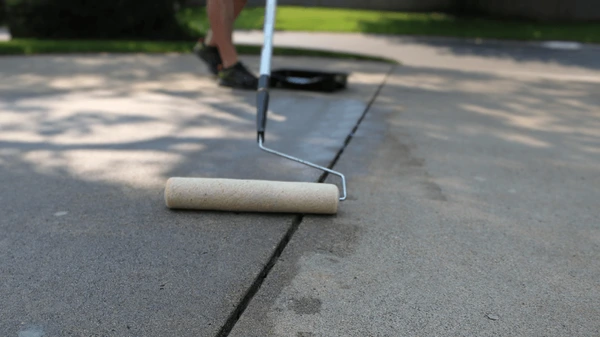
The correct product for exposed aggregate is a penetrating sealer, also called an impregnating sealer. Instead of forming a film on the surface, it soaks into the voids between the aggregate particles and bonds from within the substrate. When it cures, it is completely invisible — no shine, no film, no visible coating. And it cannot peel, because there is nothing on the surface to peel off. The protection is inside the concrete itself.
Why Penetrating Sealers Are Right for Aggregate:
- Soaks into the voids between aggregate stones — no film to peel
- Completely invisible when dry unless a wet-look enhancer is added
- Survives Tennessee freeze-thaw cycling without cracking
- Does not whiten or haze under summer heat
- Can be recoated without stripping the previous layer
- Protects against red clay staining and algae re-colonization
Standard Concrete Still Benefits from Penetrating Sealers
On standard flat poured concrete, film-forming sealers can technically work. But in Middle Tennessee's climate — heavy humidity, freeze-thaw cycling, and summer heat — penetrating sealers outperform film-forming in longevity and appearance. We use penetrating sealers on both aggregate and standard concrete for most of our Mt. Juliet driveway customers.
The Cleaning Step Is Different Too
You cannot clean exposed aggregate the same way you clean standard concrete. A commercial surface cleaner at full pressure will dislodge stones from the substrate and leave divots in the surface. We use lower pressure and specific surfactants to clean between the exposed stones without damaging the aggregate itself. This is one of the most common ways property owners accidentally destroy their driveway — hiring a crew that treats it like standard concrete.
Pricing Premium — and Why It Is Worth It
Aggregate sealing runs slightly higher than standard concrete sealing because of the specialty chemistry, careful application, and longer dwell time required. Expect $200 to $400 for a typical Mt. Juliet driveway. Given that a failed film-forming sealer can cost $1,000 or more to strip and redo — and permanently damage the aggregate appearance — the premium is easy math.
If a contractor does not specifically ask whether your driveway is exposed aggregate and cannot tell you which sealer they plan to use and why, do not let them seal it. It is one of the easiest ways to ruin a premium driveway.
Ready for Knockout Results?
Protect your exposed aggregate driveway the right way — get a free Mt. Juliet sealing estimate from Knockout.
Get a Free Quote