
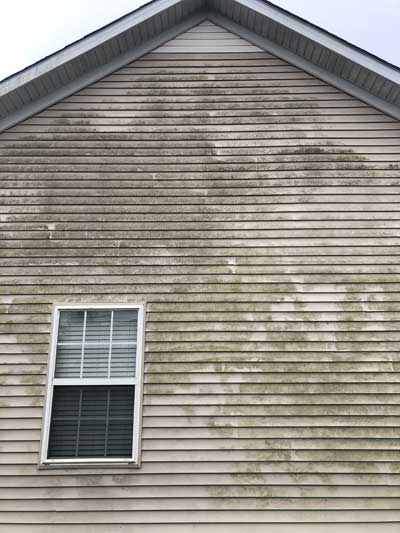
If you have dark streaks running down your roof — usually starting on the north-facing slope or in shaded sections — you are not looking at damage, age, or manufacturer defects. You are looking at a living organism called Gloeocapsa magma, a cyanobacteria that feeds on the crushed limestone in asphalt shingles. It is extremely common in Middle Tennessee, it spreads from property to property through airborne spores, and it is one of the most frequently misunderstood roofing issues homeowners encounter.
Why Gloeocapsa Magma Is a Problem Beyond Appearance
The visual impact is the first thing homeowners notice — a roof that looks years older than it is. But the more significant issue is what the bacteria does structurally. Gloeocapsa magma develops a dark protective layer that retains moisture against the shingle surface. Shingles that stay wetter longer break down their asphalt compounds faster, losing granules at an accelerated rate. In Wilson County's already-humid climate, a heavily colonized roof can lose years of effective service life.
Why It Appears First on North-Facing Slopes
Gloeocapsa magma thrives in shade and moisture. North-facing roof sections receive the least direct sunlight, dry out the slowest after rain, and stay hospitable to the bacteria year-round. This is why the streaking almost always starts on one side of the roof and spreads. Homes under or near mature trees accelerate this pattern significantly because leaf debris traps moisture against the shingles.
The Only Safe Removal Method: Soft Washing
The Asphalt Roofing Manufacturers Association — ARMA — specifically recommends soft washing as the correct cleaning method and explicitly warns against high-pressure washing on shingles. High-pressure washing strips the protective granules from asphalt shingles, can dislodge flashing, and voids manufacturer warranties on most shingle brands. We turn down requests to pressure wash roofs because it causes more damage than the bacteria it removes.
The ARMA-recommended soft wash process:
- Pre-wet and protect all landscaping, gutters, and downspouts
- Apply a diluted sodium hypochlorite solution with biodegradable surfactant at low pressure
- Allow the solution to dwell on the shingle surface, killing the bacteria at the root
- Rinse gently — the treated areas lighten immediately as the biology is neutralized
- Flush gutters and downspouts to remove any collected runoff
How Long Do Results Last?
In Wilson County's climate, a professionally soft-washed roof typically stays clean for two to four years. Shaded north-facing slopes and properties near Old Hickory Lake or Percy Priest see regrowth sooner. Open, sunny roofs can hold results closer to four or five years. Results are visible on the day of treatment and continue improving over the following weeks as dead bacteria washes away with rain.
What Happens If You Leave It
Gloeocapsa magma does not go away on its own — it spreads. A colony that starts on the north slope will, within a few seasons, cover the entire roof if left untreated. Beyond structural and energy implications, there is the straightforward property value issue: a streaked roof signals deferred maintenance to buyers and appraisers. A roof cleaning that costs a few hundred dollars can protect thousands of dollars of negotiated home value.
We provide ARMA-compliant roof soft washing throughout Mt. Juliet, Lebanon, Hermitage, Hendersonville, Gallatin, and surrounding Middle Tennessee. Free estimates, no pressure on the shingles — that is the guarantee.
Ready for Knockout Results?
See black streaks on your roof? Get a free soft wash estimate from Knockout — the only method that won't damage your shingles.
Get a Free Quote