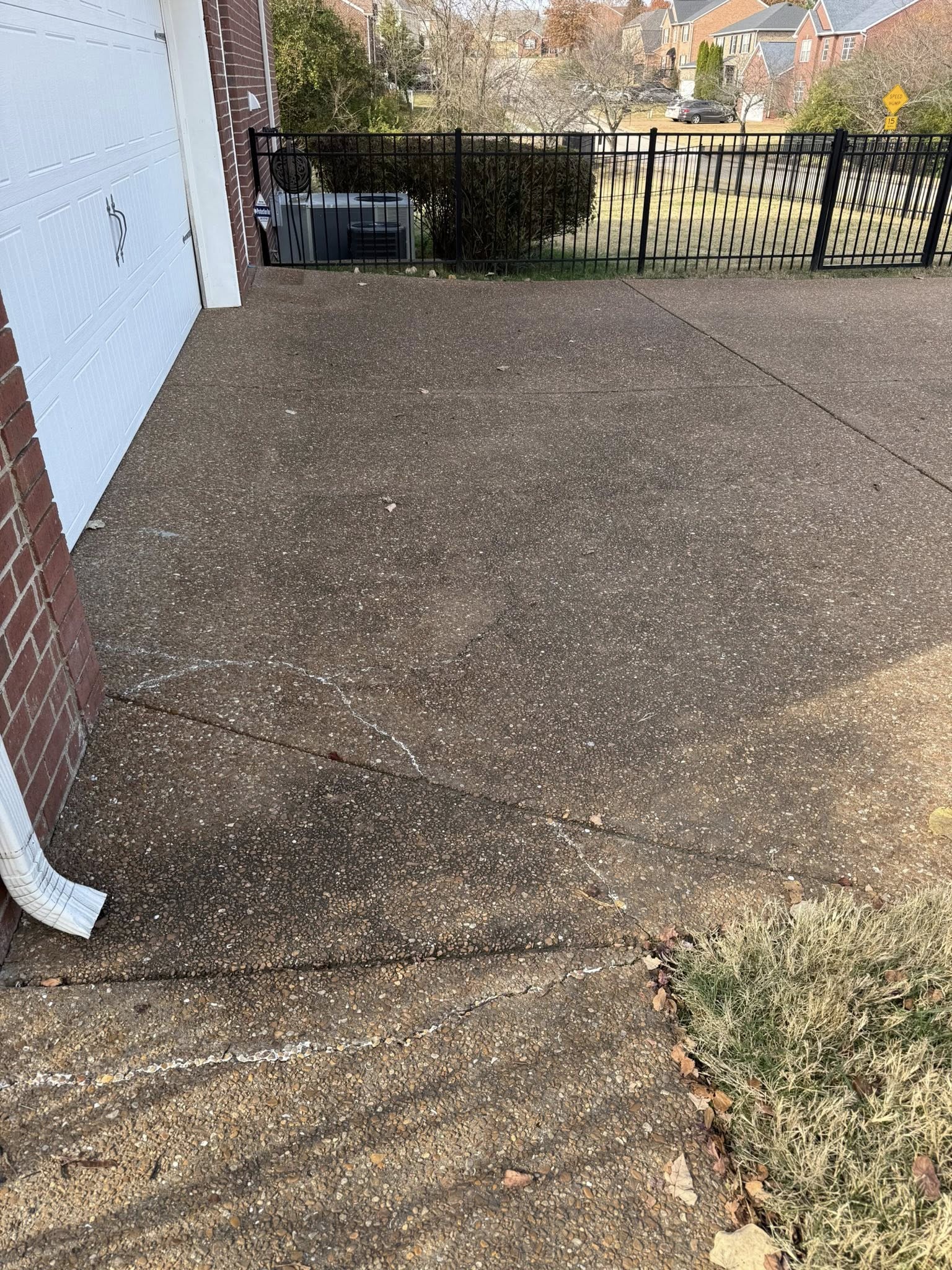
If you have noticed your Mt. Juliet or Lebanon driveway getting progressively darker, greener, or streaked with black, you are not looking at dirt. You are looking at a mature algae colony — and Wilson County is one of the most aggressive environments for concrete algae in Tennessee.
Why Algae Loves Wilson County Concrete
Four things feed driveway algae: humidity, shade, organic debris, and porous concrete. Wilson County gives algae all four in abundance. Old Hickory Lake pushes airborne moisture into Mt. Juliet and Hermitage year-round. Heavy tree canopy in established neighborhoods like Providence, Del Webb Lake Providence, and Five Oaks keeps driveways damp well past sunrise. Leaves and pollen give the algae food. And concrete itself is porous — the top layer holds moisture like a sponge.
The Red Clay Problem on Newer Driveways
If you live in a newer Wilson County subdivision — anywhere there has been construction within the last five to ten years — you are probably also dealing with red clay staining. Tennessee red clay is rich in iron oxide, which chemically bonds to concrete when it gets wet. Rain washes clay off neighboring construction sites and across your driveway, where it permanently stains the surface unless treated with an acid-based remover. This is why new-construction driveways often look worse than older ones.
Why DIY Pressure Washing Falls Short
Consumer pressure washers simply do not have the flow rate to run a proper surface cleaner. Using the wand alone leaves visible zebra stripes across the concrete — you can see the wand pattern in the final result. Without pre-treatment, the algae roots are still in the concrete pores, and regrowth starts within weeks. Worse, a concentrated nozzle held too close can etch the concrete surface, permanently damaging the top layer.
Common Driveway Cleaning Mistakes Homeowners Make:
- Using the wand instead of a surface cleaner — leaves zebra stripes
- Skipping the pre-treatment step — algae regrows in weeks
- Holding the tip too close and etching the concrete
- Mixing chemicals incorrectly and bleaching landscaping
- Cleaning without addressing red clay with the right acid treatment
- Never sealing afterward — the clean lasts half as long
The Professional Process
Our process for a Wilson County driveway starts with an alkaline degreaser pre-treatment that dwells on the surface long enough to kill the algae at the root. If red clay is present, we add an acid-based iron remover to break the chemical bond between the clay and the concrete. Then we use a commercial rotary surface cleaner — not a wand — to deliver even cleaning pressure across the full slab. The result is a uniform, streak-free finish with no wand lines.
Why Sealing After Cleaning Matters
A freshly cleaned driveway is the only right time to seal. A penetrating sealer closes the concrete pores that algae and clay use to anchor themselves, dramatically slowing re-colonization and extending the clean appearance by years. In the TN freeze-thaw cycle, a sealed driveway also resists cracking and spalling much better than bare concrete.
Ready for Knockout Results?
Stop fighting algae on your Wilson County driveway — get a free instant estimate from Knockout Pressure Washing.
Get a Free Quote