
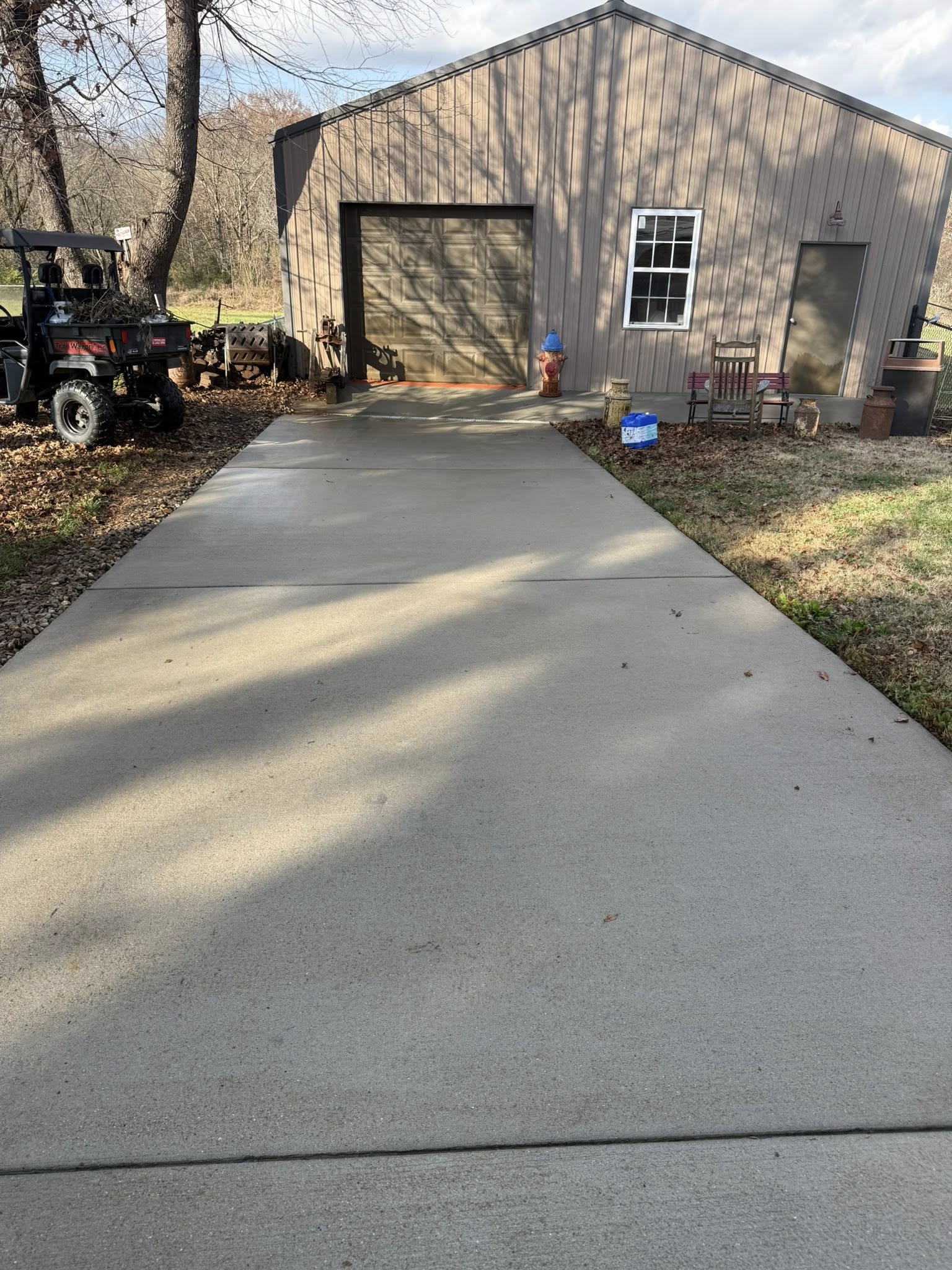
If you have a driveway in Middle Tennessee — especially near new construction in Mt. Juliet, Lebanon, or the Highway 109 corridor — you have probably dealt with that rust-orange staining that appears after every rainstorm. It is Tennessee red clay, and it does not behave like regular dirt. Standard pressure washing will remove loose clay, but it will not touch the staining underneath. That rust-orange color is iron oxide that has chemically bonded to the porous surface of your concrete, and removing it requires chemistry, not just pressure.
Why Red Clay Stains Are Different
Red clay gets its color from iron oxide — the same compound that makes rust red. When clay-heavy soil splashes onto a concrete surface, the iron oxide seeps into the microscopic pores of the concrete and forms a chemical bond. Once it dries, it is effectively locked in. A standard pressure washer can remove the clay sitting on top of the surface, but it cannot break the bond the iron oxide has already formed with the concrete below. This is why homeowners will sometimes power wash their driveway and get it looking clean briefly, only to find the orange tint remains.
The Correct Process for Red Clay Removal
The professional red clay removal process:
- Apply an iron-oxide surfactant pre-treatment to the stained area — formulated to break the chemical bond between iron oxide and concrete
- Allow the product to dwell for 5 to 15 minutes depending on the age and severity of staining
- Agitate with a stiff brush on heavy buildup areas to work the product into the pores
- Flush the surface with a commercial-grade rotary surface cleaner
- Final rinse to remove all product residue and confirm results
DIY Options and Their Limits
Oxalic acid-based concrete cleaners at home improvement stores work on the same principle as professional iron-oxide surfactants. They do work to a degree, particularly on fresh staining. The limitations are concentration, rinsing power, and results on multi-year buildup. If the staining is recent and light, a consumer oxalic acid product plus a decent pressure washer will make a meaningful difference. If it has been building for multiple years, realistic DIY results are improvement rather than full removal.
Preventing Red Clay From Coming Back
The most effective prevention is sealing your concrete with a penetrating concrete sealer after a proper cleaning. A penetrating sealer closes the pores so the next time clay-heavy runoff hits your driveway, the iron oxide has nowhere to bond. For driveways near active construction zones in Mt. Juliet or Lebanon, sealing is especially worth doing because the clay exposure is ongoing. We offer driveway cleaning and sealing as a combined service.
When to Call a Professional
Call a professional when the staining has been there for more than a year, when consumer products have not moved it, or when you want results rather than just improvement. A professional crew has commercial-grade iron-oxide chemistry, the right dwell management for Tennessee heat, and the equipment to flush the entire surface evenly without wand lines. We serve Mt. Juliet, Lebanon, Hermitage, and all of Wilson County. Free estimates, no travel fee in Wilson County.
Ready for Knockout Results?
Dealing with red clay on your driveway? Get a free estimate from Knockout — we specialize in Tennessee red clay removal.
Get a Free Quote